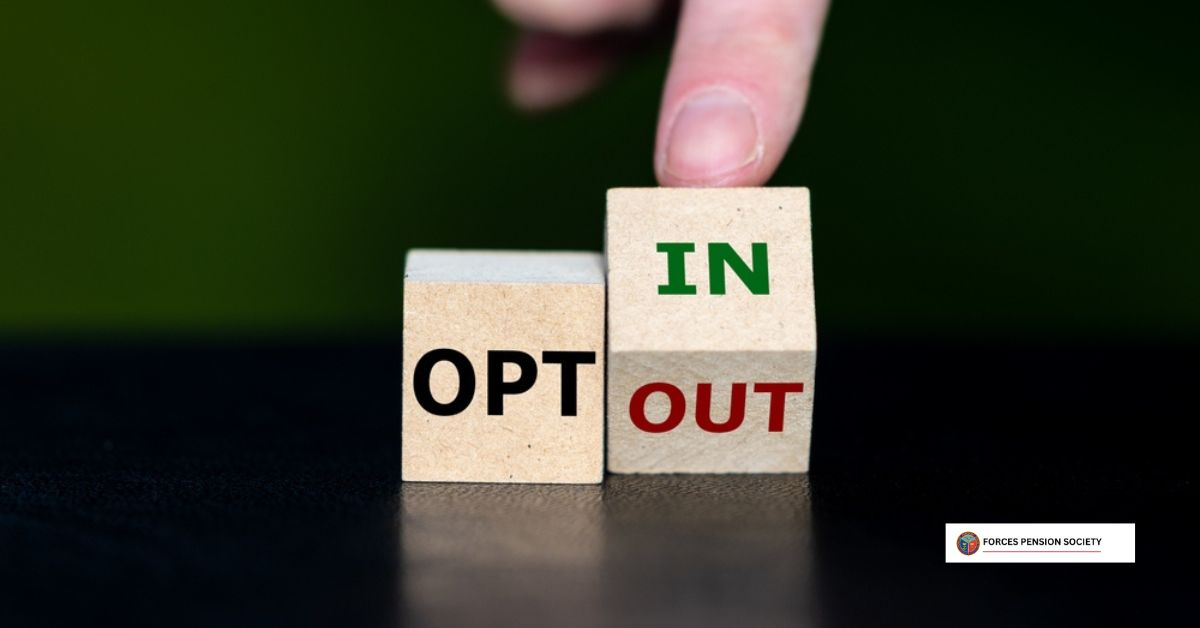
It is, perhaps, a little-known fact that service personnel can opt out of the Armed Forces Pension Schemes at any point in their service. Of course, most people’s first thought maybe: why would you want to opt out of a financially non-contributory scheme.
In this article we will look at how the opt out can be done, consider some of the reasons as to why service personnel may do so and, perhaps most importantly the implications of opting out and therefore missing many of the valuable benefits of the schemes.
Most pension schemes require both employer and employee to make monthly contributions to a pension pot – in essence a fund made of pension contributions. However, given the nature of armed forces life the armed forces pension schemes are financially non-contributory. Service personnel do not pay any contributions from their salary into the pension, it is free and the pension when paid is guaranteed because it is funded by the government. The FPS deliberately describes it as financially non-contributory as we consider service personnel contribute through selfless commitment.
However, service personnel can opt out of the scheme at any time. Anyone joining the services can initially opt out within three months by writing to their commanding officer. Thereafter opting out remains a simple process of letting Veterans UK know in writing by submitting an AFPS Form 16 – found online. Even if a service person opts out, they would still be entitled to the Resettlement Grant, Early Departure Payment and any Redundancy.
Rejoining the scheme is, too, a simple process of letting Veterans UK know in writing and can be done once in any 12-month period and if the service person remains in service and is under the pensionable age for their respective schemes. Any opted out period would not count towards pension benefits.
Some people may, for example, opt out in the mistaken belief that it increases their take home pay, others that if they are only serving briefly, it’s not worth accruing a pension that won’t pay until later. Whilst long-serving personnel may worry about breaching HMRC pension tax thresholds, which can lead to tax bills. However, opting out for these reasons would seem to make no sense as the scheme is non-contributory and despite any tax concerns there is no overall financial loss compared with being in the Scheme. We would recommend that independent financial advice is sought on the implications of opting out before any final decision is made.
The AFPS pays a guaranteed defined benefit index-linked pension for life. In addition, it has generous ill-health and dependants benefits in the event of the death of serving and retired personnel. The FPS considers this as one of the five pillars of the scheme and is a “reciprocal element of selfless commitment and recognises that the military family extends beyond serving personnel by also providing dependents with appropriate benefits in the event of a death”.
Opting out of the AFPS would mean that the individual would not be entitled to those ill-health benefits in the event of medical discharge or dependents benefits if they were to die. Ill-health benefits will, for example, pay a tax-free lump sum and/or an immediate pension dependent on the nature of the injury/illness sustained and its impact on the ability of the service person to work outside the military. The ill-health and death benefits are essential reassurance to those that willingly put themselves in harm’s way that they and their dependants will be supported.